Showing posts with label home loan calculator. Show all posts

Thursday, 18 May 2017

Tax Benefits on Home Loan in India

A very important criterion to be kept in mind while taking a home loan is the Tax Benefit on Home Loan. In the union budget announced on 1st Feb 2017, the Finance Minister has made significant changes with respect to tax benefit on home loan.
So, here we will discuss about these changes and further tax benefits on home loan.

Some points we will discuss here—
  • Tax benefit on home loan for under construction property before possession
  • Tax benefit on home loan for individual applicant
  • Tax benefit on home loan for co-applicant, co-borrower and joint owner
  • Tax benefit on home loan for second home

 Tax benefit on home loan for under construction property before possession
Booking an apartment which is under constructed is sometimes cheaper.
If you have taken a home loan for purchasing under construction property, you can claim tax deduction on the interest paid during the construction year after construction is completed and property possession is given to you but there is no tax deduction on principal repaid during the construction period.
According to Section 24 of IT Act, you can claim deduction against the interest amount that you have paid on your housing property during the pre-construction period.
Tax benefit on home loan for individual applicant
EMI is typically divided into principal and Property Loan Emi Calculator.

Principal is allowed as deduction from your gross total income (subject to an overall cap of 1.5 lakh with other eligible investments).Interest payable on self-occupied property is subject to a maximum deduction of 2 lakh under the head ‘income from house property’.

It can be set off against other income, in the same year. This reduces your tax liability. But to claim this, it is essential that the acquisition or construction is completed within 5 years from the end of the financial year in which the loan was taken; else the deduction will be limited to 30,000.

[Source: testblog.in/regroblog/2017/02/08/tax-benefits-on-home-loan-in-india]


Thursday, 23 February 2017

Uncover 3 Things You Didn't Know About NRI Loans

Loans are an ideal financial aid, especially when there is a need for a large amount of funds. Various individuals apply for a loan when the occasion calls for it. There is a certain process along with the submission of certain documents to avail of this aid. The NRI loan is no different. This loan is available to NRIs' and follows the similar process. However, this loan is not like rest of them. It has a unique requirements and challenges. Here are three most important details you must know about NRI loans.

A NRI Loan Is A Different Package:

With a NRI loan, especially when it comes to gathering finances for a home, NRI citizens may find that this is more complex than just taking up a local home loan. Both these financial aid will require different types of documents, will have different tenures and different modes of repayments. Repayments can be done through the NRO or the NRE account. The interest rates are also higher compared to the local rates through Home Emi Calculator. To put it into perspective, NRI home loan rates are normally 0.25 to 0.50% higher. But, NRI and local residents need similar amounts as a down payment for the loan.

Owning A Home Is More Challenging:
A NRI home loan will have fixed purposes which cannot be used for any other use. This will include self-construction of property on a plot of land, financing the purchase of a plot of land that is allotted by a society or a development authority, renovation or improvement of an existing property in India or a purchase of a house that is either under construction, sale or on a resale.
This form of credit can be used for a secondary home too. It can be used for income tax rebate too. However, NRI home loan will require a long list of documents. In most cases, NRIs cannot make this acquisition without a local support. You will also need to submit your income details from the foreign country, which complicates it furthermore.
Tax Benefits Are Tougher But Available:
NRI citizens will have to pay tax in the current nation where they are working and earning. But, if there is substantial income from Indian resources, they will need to pay tax to the Indian government too. NRI's, though, can claim any tax benefits on their housing loan in India as well. It should be noted that gaining eligibility for a NRI home loan is not easy. But, it is the best source of tax rebate available for NRI's.

Now you know the different facts that go into making a NRI loan the product it is. These loans have several other benefits too that should be researched about. The Indian government has currently ensured that, if any Indian origin individual wishes to return home in the near future, he or she is more than welcome to do so. Thus, it is wise to invest in that option as and when you are able.

[Source: http://www.sooperarticles.com/finance-articles/uncover-3-things-you-didnt-know-about-nri-loans-1379863.html?]


Wednesday, 22 February 2017

Get a Best Deal on Home Loan

A house is bought using a home loan, with a certain portion being financed out of own resources of the borrower. There are a number of banks and housing finance companies in the market offering various products. It is advisable for a borrower to note down his concerns and then compare these across the board before taking a final decision on whom to borrow from and how much to borrow.
As a preliminary step, one may prepare a checklist covering these areas. Other areas of concerns may also be added. While discussing with the prospective lenders, this checklist will come in handy to make a good comparison and take a final decision.

Points for your checklist:
Purposes for which the loan is available - purchase of plot, construction, or for both
How and when the disbursement will take place Documents needed
Who can be co-applicant
What is the time taken or sanction, disbursement of loan. Generally, a bank takes 10-15 working days
Maximum loan the bank is ready to disburse
How and when the recovery through EMIs starts
In case of change in interest rate, how an adjustment in EMI will be made for interest reduction or early principal repayment
Method of calculating interest rate - daily or monthly reducing
Is a guarantor required? If yes, who can be a guarantor and documents required from him
Will the loan disbursement be made in phases depending on progress of construction or in one lump sum
Legal verification fee payable
Rate of interest and effective rate of interest. Effective rate of interest should be taken for a comparison
Commitment charges payable Processing charges payable
Procedure for switch over from floating to fixed rate or vice versa. The attendant conditions applicable and corresponding charges payable
In case of purchase of land and construction loan, will the bank sanction separate loans or a composite loan

Mode of payment of EMIs
Free or concessional insurance on the loan offered
Prepayment terms these questions constitute a preliminary checklist only. This list is not exhaustive. One may add any number of additional points. This will help in comparing and negotiating with the banks to get a good deal.

[Source: http://www.sooperarticles.com/finance-articles/loans-articles/get-best-deal-home-loan-95336.html?]


Tuesday, 7 February 2017

Going About Refinancing Home Loan

Depending on the condition you are currently in; refinancing home loan could either be an advantageous or a disadvantageous move. A lot depends on your assessing capabilities. Simply put, refinancing is an option which helps you deal with a foreclosure-like situation. If you are unable to pay up you monthly mortgages, losing your house as a result of foreclosure may be the inevitable outcome. In order to avoid losing your property, you can apply for refinancing your loan which extends a lower rate of interest than the previous one. 

They may also provide loans at much more favorable terms as they would be using your home as the collateral. The fresh secured loan will help in settling the balance mortgage amount with ease. Although the settlement seems primarily advantageous, there are several aspects which need to be taken into consideration before deciding on refinancing home loan.
When Can Refinancing Prove Cheaper?

It could seem difficult to judge if refinancing Loan for Home is after all a favorable option. You could compare the appraised value of your home to the mortgage. If the mortgage is less, refinancing home loans may be a good idea when the interest rates are depreciating. You could then refinance for the same period but at a more favorable interest rate. As a result, your monthly installments will go down.

Second, you can also apply for refinancing for a shorter period and lower interest rate. You can save the interest charges and any refinancing fees which might be charged, in both cases. What you will need is a financing calculator. You can easily download one online. The results of the calculations will tell you if refinancing at a lower interest value is actually worth it or not.

Alternatively, you might also choose to refinance the loan balance for the same time period as the original loan but at more favorable interest rates. This could bring down your mortgage amounts. Some amount of discipline will also save you money in the long run as you pay the same amount as you would have for your old mortgage.
Advantages of Refinancing Home Loan

Considering that refinancing has proved to be a favorable option for you, the advantages of refinancing home loan could be listed as below:

* Reduction Of Monthly Mortgage Payments: Refinancing home loan will allow you to land a brand-new loan at reduced and more favorable interest rates. Therefore, your monthly home loan installments can be successfully lowered.
* Transition To Fixed Rate: Refinancing will allow you to make a transition from adjustable mortgage rates to fixed rates which can be truly beneficial.
* Doing Away With PMI: When you refinance your home loan, you can do away with PMI or private mortgage insurance when you have touched 20 percent equity on your property.
* Settling Other Bills: With refinancing, it is easier to settle your current bills. You can settle your outstanding loan balance and can also deal with other outstanding amounts with ease. You can also utilize the money you have saved for other investments.

Therefore, if you go about it correctly, refinancing home loan could be a great help in times of distress.

[Source: http://www.sooperarticles.com/real-estate-articles/mortgage-financing-articles/going-about-refinancing-home-loan-496607.html?]


Tuesday, 24 January 2017

How best to reduce the burden of home loan prepayment

If you have a home loan, you may have often thought of repaying it, either in whole or in parts. What’s the best way to repay?

We receive a lot of queries from young double-income-no-kids (DINKs) clientele, whose primary and high priority goal is buying that “dream home”. On an average, one out of five clients asks such a question. They are usually in the middle of paying a home loan, or have booked an apartment and want to know which is the best method to fund it—through regular equated monthly installments (EMIs), or only interest payments for under construction properties.

What are the tax benefits that they can claim in both options? Whether the vested stocks they receive annually or the bonus they get should be directed to reduce their home loan liability? Which is the best EMI option: fixed or floating? Which option to choose when interest rates are rising or falling, and what is the fine print on “fixed interest rate”? These are just some of the questions that we receive on a regular basis.

Obviously there are many permutations and combinations, and each case is unique and requires individual analysis, calculation and guidance. The idea is to work out the best possible option for loan repayment, to enable the lowest impact of interest rate cost to the client.

Firstly, there are many ways to reduce the burden of a home loan—through prepayment (partial or full), by increasing EMIs, or shifting to another loan.

Some choose to foreclose an existing loan and take another loan with the same bank or another bank. This scenario works best in a falling interest rate regime. Mind you, there are costs associated with this, and every individual’s loan would involve weighing the pros and cons based on the client situation at hand.

Some choose to increase their EMIs (from the normal specified for a given rate of interest and tenor) to reduce the principal outgo, reduce the tenor, and thereby, reduce the interest charged by the bank. This choice is possible when other commitments such as child’s education are already being saved for or the goal has already been met. Some people prepay from the bonus that they may have received or other windfalls.

Let’s assume a client has taken a home loan a few years ago, and has a current outstanding amount of Rs.26,04,262 with a monthly EMI of Rs.36,407 to be repaid to the lender. The current interest rate on this loan is 11.75%, and the remaining tenor is 124 months.

There are four scenarios in which this Home Loan India can be repaid. The aim is to see which option works in the best interest of the client for a speedy closure and lowest cost incidence.

Scenario 1: We are assuming that the client makes no change in her EMI, and continues to make the monthly payment towards her home loan. The total interest to be paid for the remaining tenor of 124 months would be Rs.18, 99,000.

Scenario 2: We tweak the interest rate and reduce it to 10.50%, and assume that the client’s affordability hasn’t changed and she is paying the same EMI of Rs.36,407. Since, the interest rate is reduced, she can close the loan in 113 months, saving a total interest of Rs.3,94,000 over the remaining tenor of the loan.

Scenario 3: We further play with the numbers, and assume that the client will make prepayments towards the home loan from the annual bonus she receives. With the same EMI of Rs.36, 407 and assuming that the client and her spouse are able to make annual prepayments of Rs.2, 00,000 for a duration of five years, the total interest paid under this scenario will be Rs.10,49,147. And surprisingly, the loan will be completed in just 73 months, versus the original duration of 124 months. The total interest saved in this option, is a substantial Rs.8, 49,803.

Scenario 4: Lastly, we worked with the assumption that the client is able to increase her EMI to Rs.42, 000 per month (because of her annual pay hike). She will be saving a total interest of Rs.4,76,000 over the remaining tenor of the loan, and by doing this, the loan would completed in 96 months.

The result
After doing these calculations, we finally went back to the drawing board and provided the client with the analysis of our findings under different scenarios.

What we learnt was that maximum amount saved (Rs.8, 49,803) through interest was with the annual prepayment option. In this scenario, even the loan tenor came down to 73 months. But this is not a thumb rule. One must analyze factors such as the outstanding loan amount or the bank’s prepayment charges asked by banks. Apart from this, some banks also put a limit on the quantum of prepayment allowed in a year. Such clauses must be studied carefully. Then there are the client’s other goals to be seen—life insurance, healthcare, retirement planning, or even tax planning.


[Source: http://www.livemint.com/Money/DqhQ6uOxGDtpKyfEMElWwK/How-best-to-reduce-the-burden-of-home-loan-prepayment.html]

Wednesday, 18 January 2017

How interest rate increases will Impact you

December 14, the Federal Reserve raised its key short-term interest rate by a quarter-point, from 0.5% to 0.75%, which is still considered low. Most banks then raised their prime rate to 3.75% from 3.5%.

It was the second rate hike in 13 months. For most of the last decade interest rates were untouched, in an attempt to improve the economy after the financial crisis. If you applied for a credit card or even a mortgage, these low interest rates certainly helped.

The increase, which is subtle, wasn't entirely surprising, partly because 2016 has been a year of relatively robust economic growth. In fact, more than 2 million jobs have been created in the last year, and the unemployment rate fell to about 4.6%, the lowest it has been since the summer of 2007.

Low interest rates give consumers more borrowing power. When consumers spend more, the economy grows. Higher interest rate encourages people to save more, and borrow less, and reduces the amount of money in circulation. This slows the rise in prices. Learn more about how interest rates work.

One of the few surprises from the Fed's announcement is that in 2017, there may be two, or three, additional interest rate increases. JPMorgan Chase's head economist, James Glassman, offered this analysis:

“Ideally, the Fed's policies will prolong the current business cycle and keep the economy operating at its peak potential for as long as possible. In the past, the top of every business cycle has generated imbalances as the economy began to overheat. But as we approach the current peak, slightly higher interest rates may effectively discourage the creation of the asset bubbles and bad investments that could lead to the next recession."


Here's what the interest rate increase may mean for you:

Checking, savings, CDs & IRA CDs: Most banks will not automatically change deposit rates, because they aren't tied directly to the prime lending rate. The prime lending rate is used for pricing short- and medium-term loan products, such as credit cards and home equity lines of credit. (This infographic explains more about the prime lending rate.)The good news for people with savings accounts is that they may start seeing larger returns, at least in the long term.

Credit cards: Most credit cards carry a variable interest rate. So, credit card interest rates will likely go up—but modestly. It probably won't affect your ability to pay your bills each month.
Home Equity Lines of Credit (HELOC) and other variable-rate products: In general, the rate that banks charge on many HELOCs, it can be calculated through Online Emi Calculator and other lines of credit is a variable rate, so they will be affected, but only slightly since the rate hike is only a quarter point.

Adjustable-rate mortgages: These mortgages, often called ARMS, are tied to a different index which can change only at specific time periods, usually annually. The rate hike could cause your mortgage rate to increase on your next rate change date.
Existing fixed-rate loans: Interest rates on car loans, fixed-rate mortgages and other existing fixed-rate loans won't be affected. Currently, an average mortgage rate is about 4%. Going forward, that may increase, but mortgage rates vary from customer to customer, based on any number of factors.

[Source: https://www.chase.com/news/121916-interestrate-hike]


Wednesday, 11 January 2017

What’s a top up loan!

A top up loan basically allows you to avail a loan amount on top of your home loan. The usual loan tenure is about 10 years and is often offered only after a few years into the home loan disbursal, as this gives a fair idea about your repayment track record, which means no defaults down the line and this also increases your loan eligibility.

Vinita Mistry took a home loan from her friendly neighborhood bank two years ago. She bought a cute cozy apartment in a block of 60 apartments in a community enclave, which housed 300 apartments in all. At that time she did not have a four-wheeler and rode a trendy power bike to work, which was always parked under the stairway that went up to her 5th-floor apartment. She eventually moved office and upgraded to a gorgeous looking small car. Then she had a problem! Parking Space!!.

She figured she needed to buy that additionally apart from her apartment cost. She wished to take a loan to cover the cost of purchasing a parking slot. How can she go about this? Are you stumped like Vinita wanting more amenities or are you looking for some urgent funds, without expensive interest rates attached to it?  Well, a top up loan on your existing home loan might just be the answer. Let us understand the various nuances of a top up loan before you decide to shortlist this as an option.

How it works
A top up loan basically allows you to avail a loan amount on top of your home loan. The usual loan tenure is about 10 years and is often offered only after a few years into the home loan disbursal, as this gives a fair idea about your repayment track record, which means no defaults down the line and this also increases your loan eligibility.

The logic behind a top-up loan is the fact that you have already started repaying your loan, hence your outstanding loan amount with the bank has already begun decreasing with each payment. A top up just enables you to utilize that margin towards obtaining a loan that you may urgently require to meet some of your needs.

Utilizing a top up loan
Top up loans are a boon to people who are in urgent need of funds. It is almost like a personal loan, except that it comes with better interest rates though not as good as home loan rates but is based on the prevailing rack rates. You can utilize this loan for any purpose. A top loan on your existing home loan is an ideal choice to pay for your parking space or to fund your son’s higher education for instance.

Eligibility
You can take a top up only when you have a Loan for Home to top up on. The conditions for top up loans vary from bank to bank. You can approach the same bank in which you took your home loan but if your bank does not offer you the option, as some reserve the right to provide a top up, then you could shift the home loan to a bank that is willing to give you a good deal on the top up loan. Keep in mind that you need to have an impeccable repayment track record.

The outstanding loan amount pending with the bank, the market value of the property and your ability to repay a top up, are all taken into account to figure out how much top up the bank gives you. In fact the upper limit on the loan amount is defined based on these three aspects.  It is always ensured that the outstanding loan amount you owe the bank plus the top up personal loan does not increase beyond around 70% of the market value of the property. Also, each bank will have its own upper limit and the loan amount will be restricted accordingly.

Tax benefits
Tax benefits are dependent on the purpose for which the loan is utilized. For Vinita, the loan is for parking space, which is part of property acquisition. Hence, she would be eligible for a tax rebate on both the principal and tax repaid towards the top up loan capped at Rs. 1 L and Rs. 1.5 L respectively, which is inclusive of the rebate she would avail from her current home loan.

A sample calculation for Vinita’s top up loan
Let us assume Vinita has taken a loan of Rs.30 L at a 12% interest rate for a period of 20 years and as specified is now in her third year into the loan.
Let us make another assumption that from the time she purchased the property, the value has risen by Rs. 20 L, which pegs the current market value of the property at Rs.50 L.
70% of Rs. 50 L = Rs. 35 L (70% of the value is taken as the margin beyond which the loan will not exceed)
Next, the outstanding loan amount is deducted from the above figure:
Three years into the loan she would have repaid a principal amount of Rs.1.31 L
Remaining Principal amount to be repaid – Rs. 28.7 L
Rs. 35 L ( 70% of market value) – Rs. 28.7 L (principal yet to be repaid) = Rs. 6.3 L
Hence the maximum top up loan she will be eligible for based on this example, is Rs. 6.3 L.
However to avail a top up loan, factors like your repayment capacity based on your income and commitment towards any other loans other than your home loan etc., will be factored in before the bank decides on the exact top up loan amount they can offer you.


[Source: https://blog.bankbazaar.com/need-more-from-your-home-loan-take-a-top-up-loan/]

Tuesday, 10 January 2017

Why it makes more sense to switch your home loan after this interest rate cut

If not all then at least the old borrowers who have been servicing their EMI's based on the erstwhile base rate system of lending, stand to benefit. Even though bank's base rate hasn't come down as much, they now have a stronger reason to switch to the current MCLR-based lending. With the recent interest rate cuts on loans by banks the differential between base rate at which old borrowers are servicing their loan and the current MCLR is widening.

For those who had taken loans after July 1, 2010, but before April 1, 2016, the loans are linked to the bank's base rate. And for most of these borrowers, the home loan interest rate is around 10 per cent. After the recent rate cuts announced by banks, the average MCLR has fallen to about 8.75 percent or even lower. This differential of 1-1.25 percent in base rate and MCLR will help old borrowers to switch to MCLR and save on total interest outgo.

Why to switch now
The primary reason to switch from base rate to MCLR has to be the sluggishness seen in banks' passing on the benefits of RBI rate cuts to borrowers. RBI's repo rate cuts were not reflecting in the bank's base rate but are a part of the factors that goes into calculating the bank's MCLR so, the moment repo rate changed, MCLR was impacted.

Further, the MCLR takes into account the marginal cost of funds which includes the rate at which the bank raises deposits and other cost of borrowings. With banks flush with funds post demonetisation, the bank's CASA deposits (current account-savings account) have swelled and have given the banks the leeway to go for such major rate cuts.
The base rate, on the other hand, has seen only marginal reduction since last 24 months. Post demonetisation, banks are expected to wait and see the impact once the restrictions on cash withdrawals are removed. If the funds don't move out from the banking system in significant amounts, further rate cut is expected.
MCLR based borrowers
For the new home loan borrowers who have taken loan after April 1, 2016, there's not much immediate benefit from the recent rate cuts. For most MCLR-linked home loan contracts, the banks reset the interest rate after 12 months for their home loan borrowers. So, if someone has taken home loan from a bank say in May, 2016, the next re-set date will be in May, 2017. Any revisions by RBI or banks will not impact their EMIs or the loan till the reset date it is done through Home Loan Emi Calculator

What's MCLR mode of lending
A new method of bank lending called marginal cost of funds based lending rate (MCLR) was put in place for all loans, including home loans, given after April 1, 2016. Under the MCLR mode, the banks have to review and declare overnight, one month, three months, six months, one year, two years, three years rates each month.

Watch outs
In a falling interest rate scenario, quarterly or half-yearly could be a better option, provided the bank agrees. But when the interest rate cycle turns, the borrower will be at a disadvantage. After moving to the MCLR system, there is always the risk of any upward movement of interest rates before you reach the reset period. If the RBI raises repo rates, MCLR too, will move up.

Options for base rate borrowers
When the interest rate on your loan goes down banks, on their own, typically reduce the tenure automatically (instead of reducing EMI amount) and thereby, transfer the benefit of lower rate to the customers.

The base rate borrowers now have two options - switch to MCLR based lending with the same bank or else transfer i.e. get the loan refinanced from another bank on MCLR mode. One may also continue the loan on base rate, especially if the loan term is nearing the end.

The RBI has made it clear that banks should allow base rate borrowers to switch to MCLR. The existing loans can run till maturity or borrowers can switch to MCLR on mutually agreed terms.

Switching from base rate to MCLR within the same bank
It makes sense to switch if the difference between what you are paying and what the bank is offering now as MCLR is significant. And also in cases where the time for the home loan to finish is not near.

Switching loan from base rate to MCLR with another bank (refinancing)
If your bank is offering a high home loan interest rate (MCLR plus spread) then look for refinancing. Gets the loan refinanced from a bank offering a lower interest rate. You may have to incur processing fees. However, banks are not allowed to charge foreclosure or full repayment charges. Other charges may include lawyer's fees, mortgage charges, etc. Remember, the bank may ask you to buy a home loan insurance cover plan, which is not mandatory. Get the loan insured through a pure term insurance instead, in addition to any insurance that you already have.


[Source: http://economictimes.indiatimes.com/wealth/borrow/switch-home-loan-on-base-rate-to-mclr-to-cut-interest-burden/articleshow/56326321.cms]

Saturday, 31 December 2016

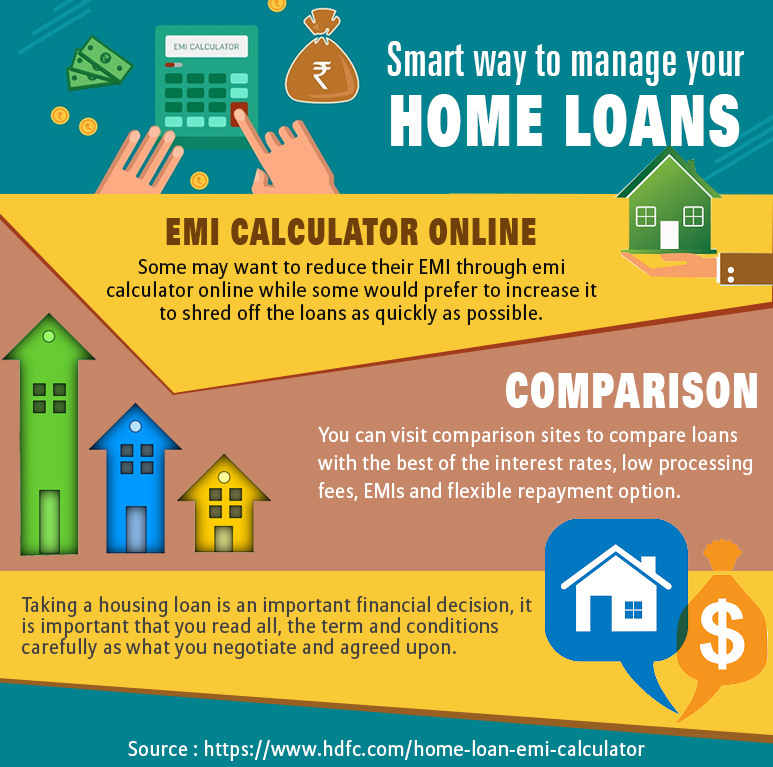
Smart ways to Manage your Home Loan


Use the interactive home loan emi calculator to calculate your home loan EMI. Get all details on interest payable and tenure using the housing loan calculator


Wednesday, 28 December 2016

Become a Proud Home Owner with the Help of a Home Loan

The society that we live in is changing with every passing year. This is not just limited to the spending habits of the public, even the basic mind-set of the people has been evolving. Traditionally, joint families were the ideal form of living. However, nowadays more and more people are opting for nuclear homes rather than living with their parents.
Thus, it goes without saying that the number of home owners has increased in the recent past. It order to make the house an asset that is within the reach of the general public, banks offer loans that are especially designed for the purchase of property.

With the help of these loans, purchases can be made on credit and the amount can be repaid to the bank in installments. This amount is calculated taking a number of different factors into consideration. This includes; the principal amount, rate of interest, tenure of the loan and the method of computation. You can find this figure yourself, using an EMI calculator.

These calculators are available online and will help you compare the offers of different banks before narrowing it down to a couple. A home loan emi calculator will help you to get an overview of how much you will have to pay the bank on monthly bases, in order to repay your loan in time. This is an extremely beneficial tool as it will help you understand how much of your income will go towards repayment of the loan. It is important to avoid a loan that is more than 60% of the monthly income, as it will be difficult to make payments in time.

Default payments can hamper the credit score and affect the chances of getting a good rate of interest in the future. This score is calculated taking the past finances into consideration. This includes everything from payment of credit card bills on time to bouncing of cheques. If you have a good credit score, the rate of interest changed of the loan will be low. However, if you do not have a good credit score, it will be difficult to even get a loan.
Similarly, your past financial record and the monthly income in sued to determine the maximum amount you are eligible to receive as credit. Although banks can offer a loan of up to 80% of the cost of the property, the amount actually offed depends on the state of your finances.

In order to reduce the amount to be paid on monthly bases, you can choose a home loan that spreads over a long tenure. However, while doing this, you must keep in mind that the amount you will be paying as interest will increase. Hence, it is important to make sure that the monthly installments are easy on the pocket, without having the cost of interest pile up.

It is important to take these things into consideration while selecting a loan. Steps must be taken to constantly improve credit score so that when you do apply for a loan, you are sure to get a good rate of interest.

[Source: http://www.sooperarticles.com/finance-articles/loans-articles/become-proud-home-owner-help-home-loan-1229597.html?]


Tuesday, 13 December 2016

The Different Methods of Calculating Home Loan EMI

Most first time borrowers are under assumption that calculating home loan EMI is easy. All you need is a housing loan EMI calculator. You have to agree with that. It does seem like if you have EMI calculator for home loan, all you need to do is enter right numbers. But, believe it or not it is more complex than that. Here are two reasons. Firstly, lots of factors in the equations remain unaccounted for. Secondly, EMI calculator will not help you get the specifics you actually need. So, here are three common methods.

Manual calculations:

Most of the formulae for home loan EMI calculations are available online. You can easily note them down and calculate EMI as per repayment option, home loan tenure, etc. The ease of doing them manually depends on your mathematics skills. But, most websites do offer an example in order to assist readers calculate home loan EMI. This process is the most tedious one. But, there are few high-level calculations you cannot see with online tools. For example, EMI as per balloon repayment option. Manual calculation is the way to go.

Online calculations:
Most borrowers are familiar with Emi Calculation for Home Loan. Thing is, there are a lot of housing loan EMI calculators in India. All of them do not offer real help. Some are just an online version of basic mathematical calculator. Yet, it does simplify your job, especially if you are not a maths geek. But, there are some efficient EMI calculators for home loan. They support your calculations well with several additional online tools like amortization table. DHFL has one of the best EMI calculators in housing finance industry.
Computer calculations:

You can use excel sheets on a computer to get the job done. It will be as good as some of the online EMI calculators. But, with basic asthmatics skills and few formulae, you can check the basic structure of repayment options too. However, it is not as good as some of the advanced online tools.

Either way, the best method for your calculations is the one that give accurate results instantly. Online home loan calculator is a great choice but not for more customized calculations. However, you will need to know the following before you calculate the EMIs and other details. For example, cost of property, processing charges, stamp duty, legal fees, and realistic interest rates. This information can be made available to you when you meet a relationship manager for the same. Even a third-party personal finance consultant is a great person to meet for these details


[Source: http://www.sooperarticles.com/finance-articles/loans-articles/different-methods-calculating-home-loan-emi-1382560.html?]

Thursday, 1 December 2016

A Guide to Simplify Your Personal Loan EMI Calculation

EMI is an amount which is payable to banks or any other financial organization until the loan amount is entirely paid off. Basically, it is the combination of interest amount and principal loan amount which a borrower needs to pay every month. It is to be noted that the interest constitutes a large part of EMI payment in the initial stages. Although, the amount of interest repayment decreases as the tenure comes to an end.

Identify the Loan Cost & Check Eligibility Criteria for Personal Loan

Whenever you think about applying for a personal loan, the only thing that comes to your mind is EMI, which will get deducted from your bank account every month. Be it a personal, home or a car loan, the entire process begins with EMI calculation.

Eligibility conditions are as follows:

The minimum age of applicant should be 21 years and the maximum age shouldn't exceed 60 years
The applicant should have a net monthly income of 20,000 & above, in order to avail the loan hassle-freely.
The applicant should be permanently employed with a recognized organization
Self-employed/businessmen with a good credit score can apply easily.
What can be the Ideal EMI calculator for Personal Loan?

In order to get the accurate EMI on the amount you have lent, you need to calculate the amount you have borrowed, the interest that you will be paying and the money you will be paying for processing fee. Once you have all this data in your hand, you can go ahead and calculate the accurate EMI that is payable on the existing loan amount. After all the Home Loan Interest Calculation, in case you realize that the amount of EMI is exceeding your payment capabilities, you can easily reduce the loan tenure or the loan amount.

Simple Formula to Calculate Your EMI

In order to simplify personal loan EMI Calculation, you just need to enter the following information in EMI Calculator:

Principal loan amount
Loan Tenure
Rate of Interest (%)
By clubbing all these components, you can easily get the accurate payable amount on your personal loan. As a matter of fact, EMI calculator is simple to use, quick performer and easy to understand. You can calculate EMI any type of mortgage by just using this calculator. In case you wish to get a more precise number, you can enter values in the box provided in the calculator. Once the value gets changed, the personal loan EMI calculator will recalculate the Equated monthly income in most precise manner.

This is how, the personal loan EMI calculator helps in planning payments, tenure and how much amount should be borrowed with the best interest rate. Possibly, this is the easiest way to calculate EMI.

[Source: http://www.sooperarticles.com/finance-articles/loans-articles/guide-simplify-your-personal-loan-emi-calculation-1487563.html?]


Monday, 28 November 2016

Are You Choosing The Right Home Loan Policy?

Rising cost of residential accommodation is primarily one of the main reasons why home loans have increasingly gained popularity in India. There is a tremendous amount of disparity in demand and supply of 'quality' residential accommodations in India.

Home loans are easy options families can buy the house of their dreams, despite not having sufficient amount of funds. The popular types of housing loans include: Land Purchase Loans, Home Purchase Loans, Home Construction loans, Home Expansion / Extension Loans, Home Improvement Loans, Home Conversion Loans, NRI Home Loans, Balance Transfer Loans, Bridged Loans, etc.

Banks across the country provide home loans to people, allowing them to pay back the entire lump sum through EMI's -i.e. Equated Monthly Installments that are distributed over an allocated period of time. It is offered both by all public and private sector banks operating in India. These loans then become easier to pay by middle-class families in India. 


From the vast amount of banks and financial institutions, customers usually face a tough task to find the right bank/institution which offers the best home loans in India. Usually online portals help here. They offer customers the lowest possible rates through a totally online process; without having to actually go to various banks to compare loan offers and interest rates.

However, there are certain essential aspects any customer who is looking out for a housing finance should pay attention to. Some of the factors include grounds of interest rate, tenure, amount, processing fee, penalties, prepayment charges, guidelines, EMI amount and additional charges. 

A customer who is trying to find the bank/institute offering the best home loan should look for that bank which provides low interest rates, maximum amount, maximum tenure, low EMI amount, no prepayment charges, low or free from processing fee, no additional charges and easy guidelines.

An EMI has to be repaid to the bank or lending institution through proper home loan emi calculator within a specified number of months based on the rate of interest, total loan amount and the tenure of repayment that is agreed upon by both the parties. There are two basic elements in the EMI - the Principal and the Interest. An easy way to find out the total loan amount in addition to the interest accrued on it and then dividing the same by the repayment period.

Usually calculating monthly installments is quite a challenge for loan borrowers. Tools such as a home loan EMI Calculator make it easier to calculate the equated monthly installment amount. They are online calculators which can be accessible anywhere and anytime.

[Source: http://www.sooperarticles.com/finance-articles/loans-articles/you-choosing-right-home-loan-policy-1161506.html?]